Chopping Board Colour Chart: Free Download for Your Kitchen
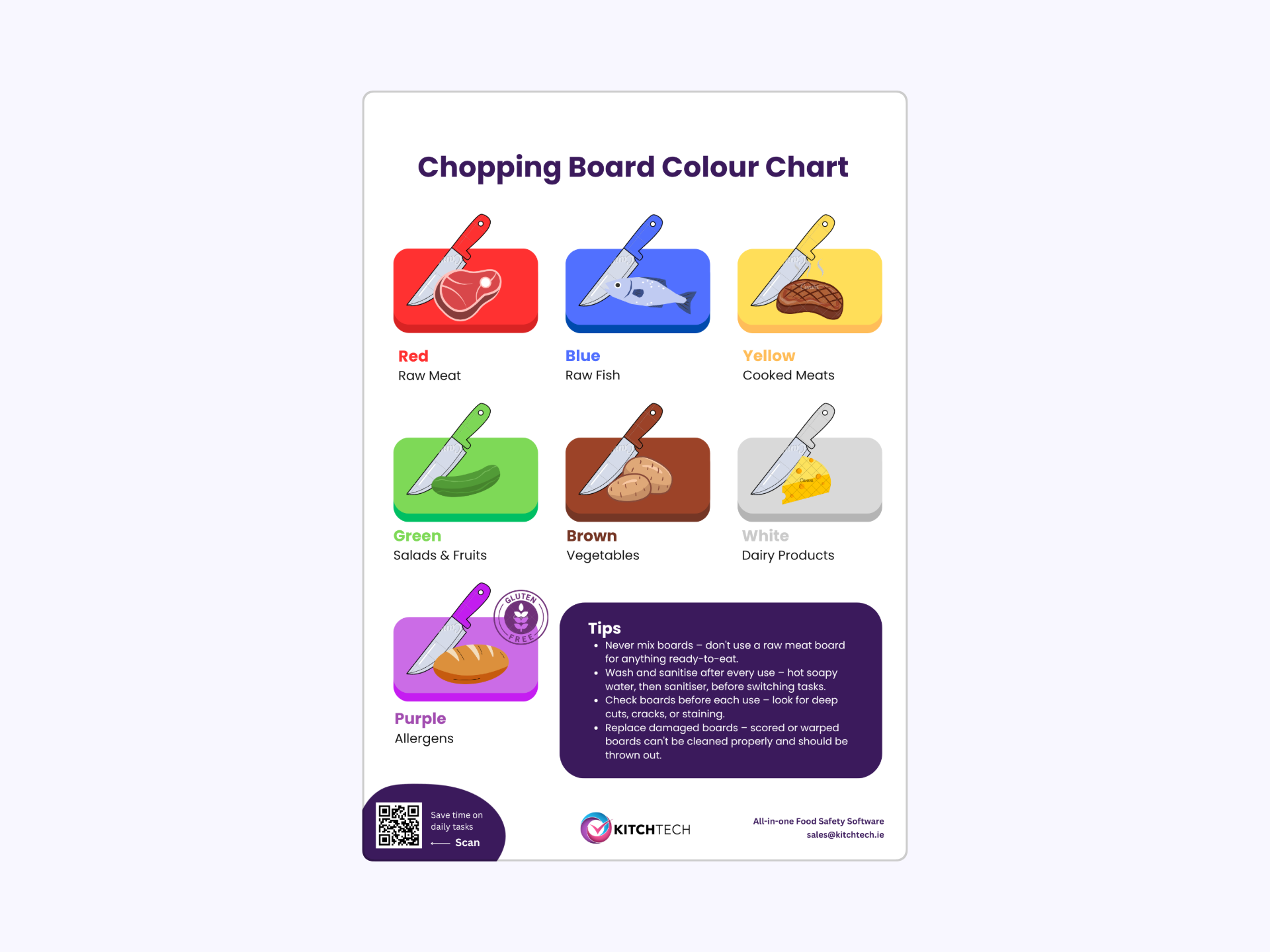
Cross-contamination causes some of the most common — and most preventable — food safety failures in professional kitchens. One raw chicken breast on the wrong board can undo weeks of good practice. It can trigger an allergic reaction, or it can fail an environmental health inspection. That’s why colour-coded chopping boards have become standard practice across catering, hospitality, care, and retail food settings throughout the UK and Ireland.
If your team doesn’t use a colour-coded system yet, or you just want a clear refresher poster for the prep area, we’ve put together a free downloadable chart. Print it and stick it up in your kitchen today.
Why Cross-Contamination Matters
Cross-contamination happens whenever harmful bacteria — or an allergen — moves from one food, surface, or person to another. It’s a leading cause of food poisoning. The Food Standards Agency (FSA) explains that it’s most likely to happen when raw food touches or drips onto ready-to-eat food, equipment, or surfaces. For example: if you chop raw chicken on a board and then use that same board for salad without washing and disinfecting it first, bacteria spreads straight across.
Raw meat, poultry, and fish can carry bacteria such as Salmonella, Campylobacter, E. coli, and Listeria. Thorough cooking usually destroys these. But if they transfer onto food that won’t be cooked again, the result can be serious illness. This is why raw and ready-to-eat foods need to stay apart at every stage: storage, preparation, and service.
Is Colour-Coding a Legal Requirement?
Many people assume colour-coded boards are a legal must-have. Strictly speaking, they’re not — UK and Irish law doesn’t name colour-coding directly. What the law does require is that food businesses take effective steps to prevent cross-contamination. Colour-coding has simply become the accepted, practical way to prove that separation to an inspector.
- In the UK, FSA guidance states that food businesses should use different equipment — including chopping boards — for raw meat/poultry and ready-to-eat food, unless they can heat-disinfect that equipment between uses. The Safer Food, Better Business (SFBB) pack reinforces this, and Environmental Health Officers use it widely across England, Wales, and Northern Ireland.
- In Ireland, the Food Safety Authority of Ireland (FSAI) advises that businesses must use separate chopping boards for raw and ready-to-eat foods, and should colour-code them where feasible. The FSAI also requires boards — wood or plastic — to stay in good repair, since deep scoring makes them harder to clean and gives bacteria somewhere to hide.
In short: colour-coding itself isn’t the law, but it’s the simplest way to show you’re meeting your legal duty to prevent contamination. Most EHOs and inspectors expect to see it.
The Standard Colour Code
- Red — Raw meat
- Blue — Raw fish
- Yellow — Cooked meats
- Green — Salad and fruit
- Brown — Vegetables
- White — Dairy products
- Purple — Allergens
UK and Irish kitchens use this system most widely, and our free printable chart follows it. Note that the scheme isn’t fixed everywhere — some kitchens use white for bakery items instead of dairy, for example. If you’re introducing a system for the first time, agree the colours as a team. Write them down in your food safety documentation. Make sure every board — and every new starter — follows the same standard.
A Note on Purple and Allergens
Purple boards for allergens are a newer addition — older charts often show only six colours. Their importance has grown since Natasha’s Law came into force in October 2021, which tightened requirements around allergen labelling for food you prepare on-site and sell prepacked for direct sale. A dedicated allergen board (and utensils) gives your kitchen a visible, easy-to-audit way to keep allergen-free dishes genuinely allergen-free. The FSAI’s guidance on allergen cross-contamination in takeaways makes the same point: dedicated, clearly identified equipment is one of your most effective controls.
Getting the Most Out of Your Boards
Colour-coding only works if good habits back it up. Here are the essentials, drawn from FSA and FSAI guidance:
- Never mix boards. Use a red board for raw meat only — never reuse it for anything ready-to-eat, even “just this once.” If you genuinely can’t use separate boards, prep vegetables and fruit first, then raw meat, fish, or poultry last. Wash thoroughly with soap in between.
- Wash and sanitise between every task. Clean first with hot, soapy water to remove visible debris. Then apply a food-safe sanitiser and leave it on the surface for its full stated contact time before you rinse or wipe. Cleaning and sanitising are two different steps — skip either one and you leave bacteria behind.
- Inspect boards before use. Deep cuts, cracks, and staining all give bacteria somewhere to hide. Both the FSA and FSAI flag this as a common inspection failure point.
- Retire damaged boards. A scored or warped board can’t be cleaned properly, no matter how well you sanitise it. When in doubt, throw it out — the FSAI specifically warns against keeping deeply scored boards in service.
- Never wash raw meat, fish, or poultry under a tap. This doesn’t remove bacteria — it splashes bacteria onto surrounding surfaces, hands, and equipment instead. Cooking properly is what makes the food safe.
Building This Into Your Food Safety System
A colour chart on the wall is a great start, but it works best as part of a documented food safety management system — HACCP-based, or a Safer Food, Better Business-style pack if you run a smaller operation. That means you should:
- Record your colour-coding policy in your food safety documentation
- Train every new starter on it before their first shift
- Include board condition checks in your daily opening or cleaning checklist
- Log when you replace boards
Download Your Free Chopping Board Colour Chart
We’ve turned all of this into a simple, print-ready poster for your kitchen wall — a quick visual reference for staff at every level, from new starters to head chefs.
Download the free Chopping Board Colour Chart
Print it, laminate it, and pin it up wherever prep happens. It’s a small step, and it makes a big difference to food safety compliance and everyday consistency in the kitchen.
Further Reading
- FSA: Avoiding cross-contamination in your food business
- FSA: Why avoiding cross-contamination is important
- FSAI: Wooden chopping boards guidance
- FSAI: Common compliance issues and controls for takeaways
Looking for more ways to simplify food safety compliance across your sites? KitchTech offers all-in-one food safety software to help your team manage daily checks, training, and records in one place.